Quick Answer
Question: Why won't my autistic child sleep?
Answer: Autistic children often struggle with sleep due to sensory sensitivities (sounds, lights, textures others don't notice), irregular melatonin production that delays natural sleepiness, and difficulty with the transition of surrendering control that sleep requires. Start by auditing their sleep environment for hidden sensory triggers, build a 60-90 minute predictable wind-down routine, and consider working with their natural sleep timing rather than fighting it.
The Moment You're In
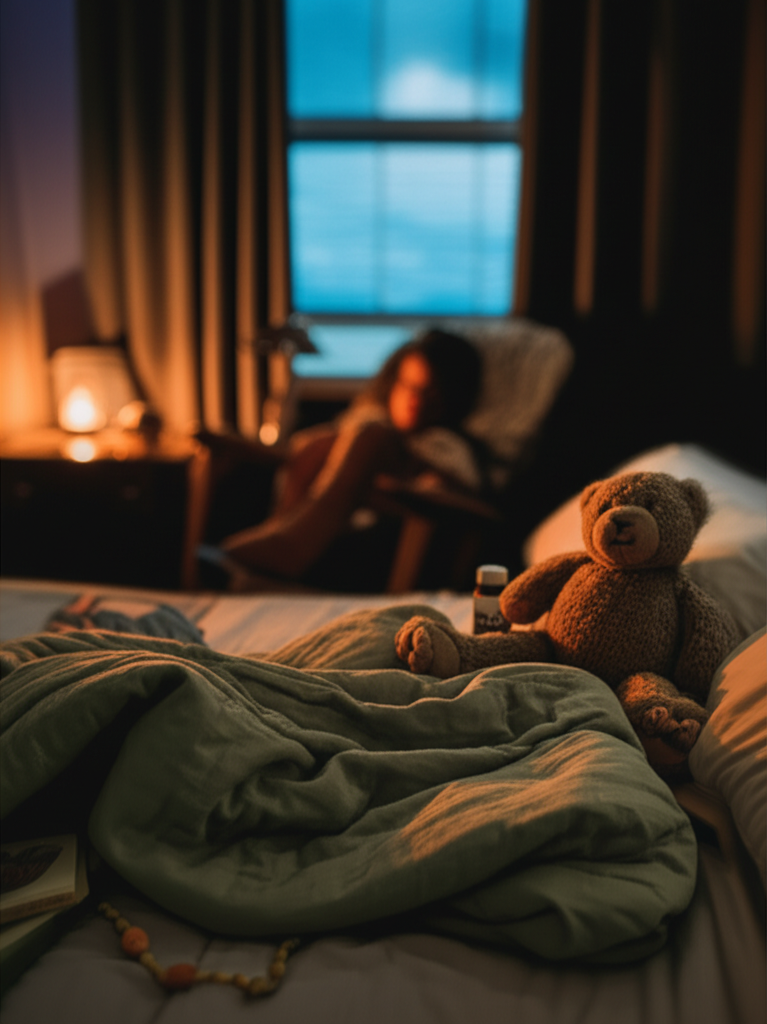
It's 11:47 PM. Your child has been in bed since 7:30, and you can still hear them humming, rocking, wide awake. The weighted blanket cost $89. The blackout curtains were supposed to be the answer. You've tried the melatonin the pediatrician suggested, the lavender diffuser your sister swore by, the white noise machine that works for every other kid. Tomorrow you have that important meeting, and you're running on three hours of sleep from last night—the same as the night before that.
You're not failing. And you're definitely not alone.
Why This Happens
Sleep challenges affect up to 80% of autistic children, making this one of the most universal struggles in autism parenting. But understanding why can transform how you approach the problem.
The sensory world doesn't quiet down on command. For many autistic children, the refrigerator humming two rooms away sounds like a truck idling outside their window. The seam on their pajama pants feels like a rope wrapped around their ankle. The "complete darkness" you created still has that tiny green light on the smoke detector—a beacon their brain can't ignore. Their nervous system isn't being difficult; it's being hypervigilant in a world that feels unpredictable.
Melatonin production often works differently. Research shows that many autistic individuals have irregular melatonin cycles, with their bodies releasing sleep hormones later—or in smaller amounts—than neurotypical peers. That 7:30 bedtime might be fighting against biology, not laziness.
The transition itself is the hardest part. Sleep requires surrendering control, letting go of the day's input, trusting that the world will still make sense in the morning. For a child who relies on predictability and struggles with transitions, this ask is enormous. Their brain may need a much longer runway to prepare for landing.
What Actually Helps
1. Engineer the Sensory Environment First
Before adjusting routines or trying supplements, audit the physical space through your child's sensory lens.
One family discovered their daughter couldn't sleep because she could hear the water heater cycling on and off in the basement—a sound the parents had long tuned out. A simple white noise machine set to brown noise (lower frequency, less harsh) masked it completely. She was asleep in 20 minutes that first night.
Another family realized their son's "favorite soft sheets" were actually causing distress because the microfiber created static electricity when he moved. Switching to jersey cotton changed everything.
Use the Sleep Environment Audit Checklist below to systematically check every sensory input.
2. Build a Sensory-Smart Wind-Down Runway
The transition to sleep should begin 60-90 minutes before you want your child actually asleep. Here's what this looks like in practice:
The Chen Family's Wind-Down (starting at 6:30 PM for an 8:00 PM sleep time):
- 6:30 PM: Lights dim throughout the house (not just the bedroom)
- 6:45 PM: 10 minutes of trampoline jumping or wall push-ups (proprioceptive input helps regulate the nervous system)
- 7:00 PM: Warm bath with unscented soap (their son finds lavender alerting, not calming)
- 7:20 PM: Weighted blanket time while Dad reads the same two books in the same order
- 7:40 PM: Quiet time with a visual timer showing 20 minutes until lights out
- 8:00 PM: Lights out, specific playlist of three instrumental songs
The key isn't copying this exactly—it's building a predictable sensory sequence that works for your child's specific profile. Sensory-seeking kids often need that burst of physical activity before they can settle. Sensory-avoidant kids might need the opposite: minimal input for that full 90 minutes.
3. Address the Anxiety Underneath
Many autistic children experience significant anxiety about sleep that they can't articulate. The dark feels dangerous. Being alone feels wrong. The loss of control over their thoughts as they drift off feels terrifying.
What addressing this looks like in practice:
Instead of "There's nothing to be scared of," try: "Your brain is working hard to keep you safe. Let's help it know that nighttime is safe too. What's one thing we could do to help your brain feel safer?"
Some children benefit from a "worry time" ritual 30 minutes before the wind-down begins—a designated 10 minutes to voice or draw their concerns, then physically "put them away" in a worry box until morning.
Others need a concrete safety signal: a specific stuffed animal that "watches over" them, a nightlight that means "Mom and Dad are still awake," or a walkie-talkie they can press (even if they never use it) to know they can reach you.
4. Work With Their Melatonin Rhythm, Not Against It
If your child consistently can't fall asleep until 10 PM despite a 7:30 bedtime, their body might be telling you something. Consider temporarily shifting bedtime later (to when they naturally fall asleep), then gradually moving it earlier by 15 minutes every few days. This "sleep compression" approach often works better than forcing an earlier bedtime that just creates hours of frustration.
Consult with your pediatrician about whether low-dose melatonin (0.5-1mg, taken 1-2 hours before desired sleep time) might help regulate their cycle. More isn't better with melatonin—higher doses can actually backfire.
📋 Sleep Environment Audit Checklist
Screenshot this or print it. Walk through your child's room at their actual bedtime and check each item.
SOUND
- [ ] Stand silently for 2 minutes. What do you hear? (Appliances, traffic, pipes, electronics)
- [ ] Are there any intermittent sounds? (Heating/cooling cycling, refrigerator, outdoor motion lights clicking)
- [ ] If using white noise, is it consistent and at the right frequency for your child?
LIGHT
- [ ] Turn off all lights and wait 5 minutes for your eyes to adjust. What can you see?
- [ ] Check for LED lights on devices, smoke detectors, power strips, cable boxes
- [ ] Look for light leaking around curtains, under doors, from hallways
TOUCH
- [ ] Feel the sheets and pajamas. Any rough seams, tags, or textures?
- [ ] Is the bedding weight right? (Some kids need heavy, some need light)
- [ ] Temperature check: Is the room between 65-70°F? Is your child too hot or cold?
SMELL
- [ ] Any strong scents? (Laundry detergent, air fresheners, cleaning products)
- [ ] Note: "Calming" scents like lavender are activating for some autistic children
VISUAL
- [ ] Is the room visually cluttered? (Can be stimulating even with eyes closed—they know it's there)
- [ ] Are there any moving elements? (Mobiles, curtains shifting, shadows from outside)
THE BED ITSELF
- [ ] Does your child feel secure in the bed? (Some need to be against a wall, some need bed rails, some need a smaller space)
- [ ] Is the pillow right? (Height, firmness, material all matter)
Frequently Asked Questions
What time should an autistic child go to bed?
If your autistic child consistently can't fall asleep until a certain time despite an earlier bedtime, their melatonin rhythm may be delayed. Consider temporarily shifting bedtime to when they naturally fall asleep, then gradually moving it earlier by 15 minutes every few days. This "sleep compression" approach often works better than forcing an earlier bedtime that creates hours of frustration.
Does melatonin help autistic children sleep?
Research shows many autistic individuals have irregular melatonin cycles, releasing sleep hormones later or in smaller amounts. Low-dose melatonin (0.5-1mg) taken 1-2 hours before desired sleep time may help regulate their cycle—consult your pediatrician. Importantly, more isn't better with melatonin; higher doses can actually backfire.
How do I create a good sleep environment for my autistic child?
Audit the room through your child's sensory lens: listen for sounds you've tuned out (appliances, water heaters), check for tiny LED lights visible in darkness, feel sheets and pajamas for irritating textures or static, and remove strong scents including "calming" lavender which can be activating for some autistic children. Keep the room between 65-70°F and reduce visual clutter.
The Bigger Picture
If you're reading this at 2 AM while your child is still awake, I see you. This exhaustion is real, and it's relentless, and it affects everything—your patience, your relationships, your ability to function at work, your own health.
You're parenting a child whose brain processes the world differently, including the transition into sleep. That's not a failure—it's a reality that requires different strategies. With the right sensory adjustments and routines tailored to your child's unique needs, sleep can improve. It takes time and experimentation, but you're already doing the hardest part: seeking to understand.
If you're navigating this right now, you don't have to figure it out alone. AriaStar is here 24/7—no judgment, just support from someone who gets the particular exhaustion of autism family life. We can troubleshoot together, adjust strategies, and find what works for your child.
Want more support? Explore our blog or talk to AriaStar.